01 - Bacteria in Space?
Cyanobacteria could produce oxygen, food and fertilizer on Mars. But growth drops 88–92% on regolith. What does that mean for a crew of four?

The biological bottlenecks of Bioregenerative Life Support Systems (BLSS)
Apollo 11 needed roughly 1 ton of consumables for 10 days in space. The shortest planned crewed mission to Mars would last around 500 days and require close to 70 tons of supplies. The most powerful rocket ever flown, Saturn V, had a maximum payload capacity of 45 tons. The math doesn't work. And that's before accounting for food. The fundamental question that needs answering is: how will these crews sustain themselves independently? The future seems promising with continuously advancing rockets and propulsion systems, but a constant resupply of food, water and oxygen is not a viable option. The solution might lie in tiny organisms that we seem to know very well, yet perhaps not well enough: Cyanobacteria.
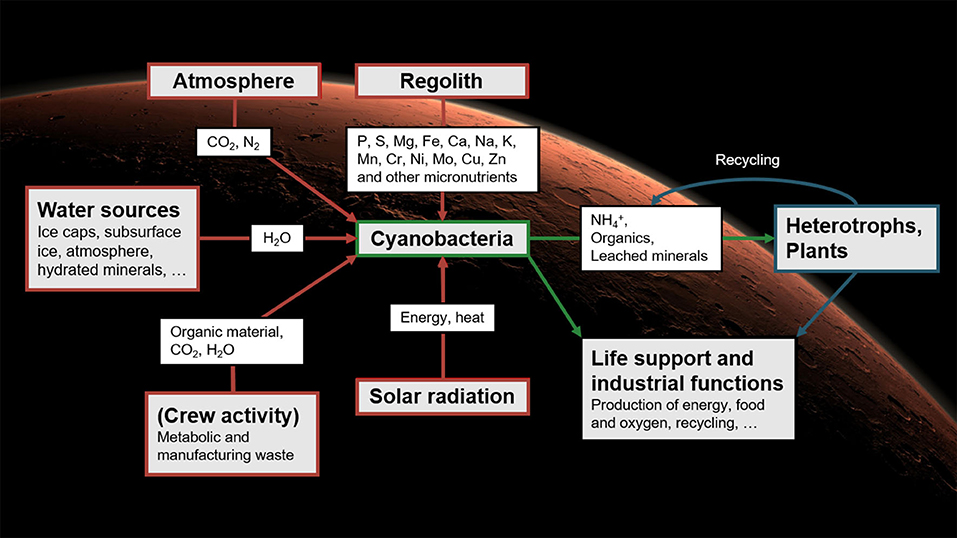
To sustain a crew in space, engineers and scientists have built life support systems (LSS). While these systems work well on the International Space Station (ISS), they heavily rely on constant resupply or physicochemical systems. Because of this dependency, such systems would have very limited applicability on Mars. Projects like MOXIE (oxygen production from atmospheric CO2 on the Perseverance rover) are undeniably major scientific advancements and important to better understand the harsh Martian conditions, but they only solve part of the problem: they don't produce food or recycle biological waste. What we need are closed loop systems, better known as Bioregenerative Life Support Systems (BLSS). These systems are essentially life-support systems that use living organisms to continuously regenerate the resources humans consume, especially oxygen, food and water. But finding the perfect organisms to complete such delicate tasks, is comparable to a galactic casting.
In order to conduct precise research with promising organisms, all of the different publications and studies need to be narrowed down. PhD student David Rodrigues and Prof. Alistair McCormick from the University of Edinburgh published a new review in which they brought together the current state of research on cyanobacteria and their use in BLSS. In their review titled "Exploring the biology of cyanobacteria in life support systems on Mars" and published in June 2026, they systematically evaluate which cyanobacterial strains are most capable in using limited local Martian resources for their metabolism (In-Situ Resource Utilization, ISRU). The main focus is: Can the microbes not only breathe in the Martian atmosphere but also be cultivated on the toxic Martian soil known as regolith.

Why Cyanobacteria?
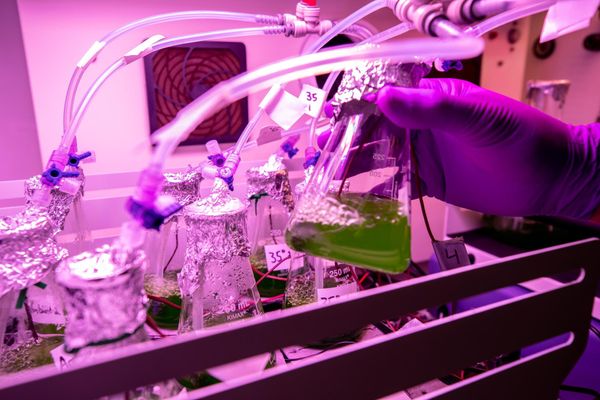
Cyanobacteria are being researched because of their various use cases: By splitting water and fixing CO2, they can produce oxygen and biomass using solar energy. While CO2 is abundant in the Martian atmosphere, extracting subterranean water ice will be the prerequisite to fuel this process. Secondly, their biomass can be repurposed in different ways. For one, some strains are safe for human consumption (others produce toxins that would need to be engineered out). A prime example is Limnospira platensis, commercially known as Spirulina, which already is used as food for its nutritional value. If not for food, the biomass can also be used as fertilizer for the soil. Lastly, cyanobacteria can be genetically modified and need to be, in order to have best adaptation to the Martian conditions. However not every strain of cyanobacteria can do everything. Some excel in oxygen production, others can fix atmospheric nitrogen. This problem is systematically examined in the review.
The Galactic Casting - 4 Strain-Categories
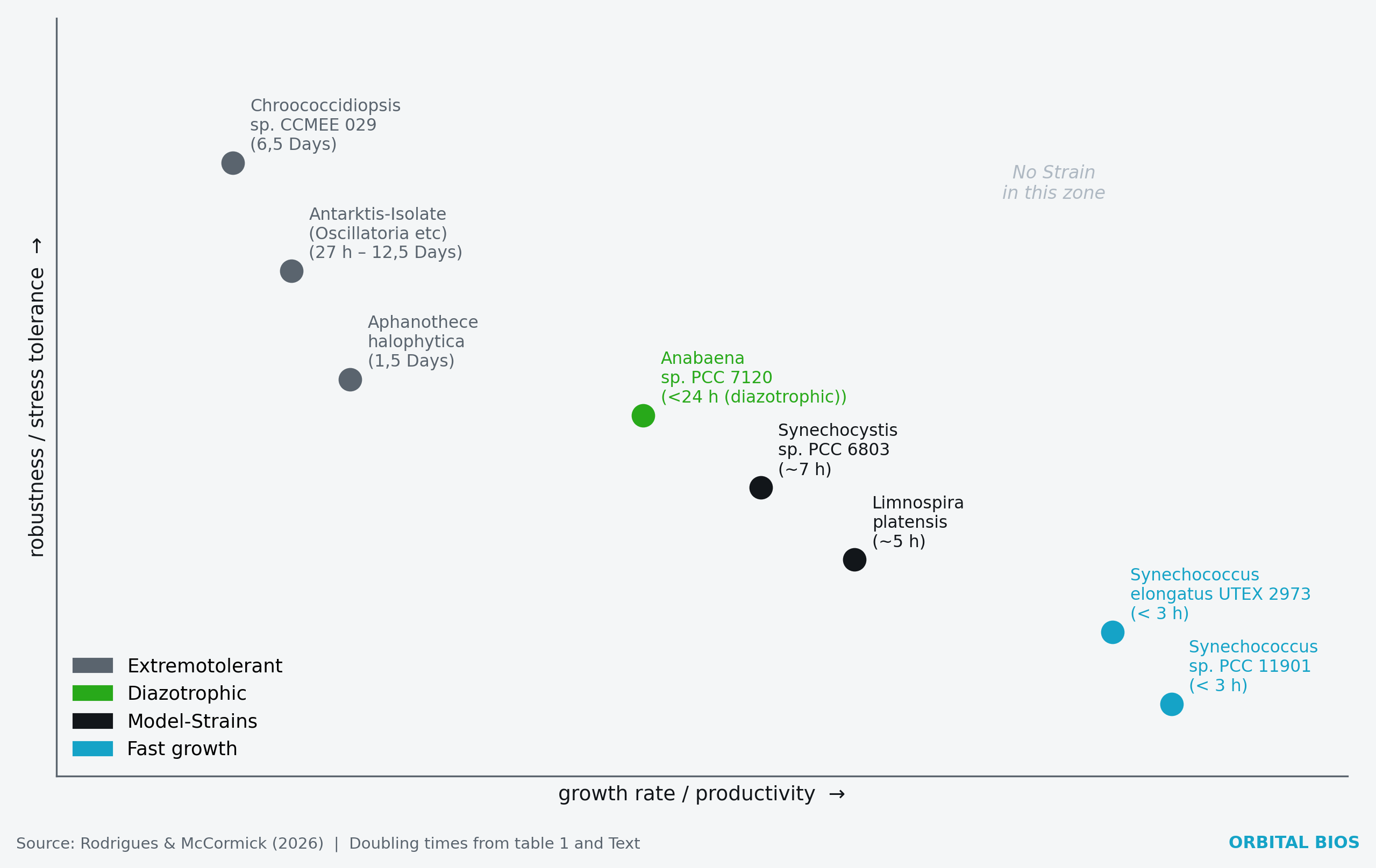
To find the right candidates to fulfill the tasks of keeping a crew alive, the different strains of cyanobacteria were categorized by four characteristics:
- Extremotolerant:
These are resilient strains. An example is Chroococcidiopsis, which survives exposure to the vacuum of space and keeps on growing afterwards. Other strains are able to grow in the desert or similar extreme environments. These capabilities come with tradeoffs: they grow very slowly with doubling times ranging from 1.5-12.5 days. These times are far too slow for any sustainable oxygen production.
- Model species:
Cyanobacterial species known as model organisms are extensively researched. Examples include Synechocystis sp. PCC 6803 and Limnospira platensis. They are comprehensively understood, feature solid growth rates, and are supported by extensive genetic toolkits. Current research heavily focuses on genetically modifying these specific strains to enhance stress tolerance or tailor their metabolic outputs.
- Diazotrophic:
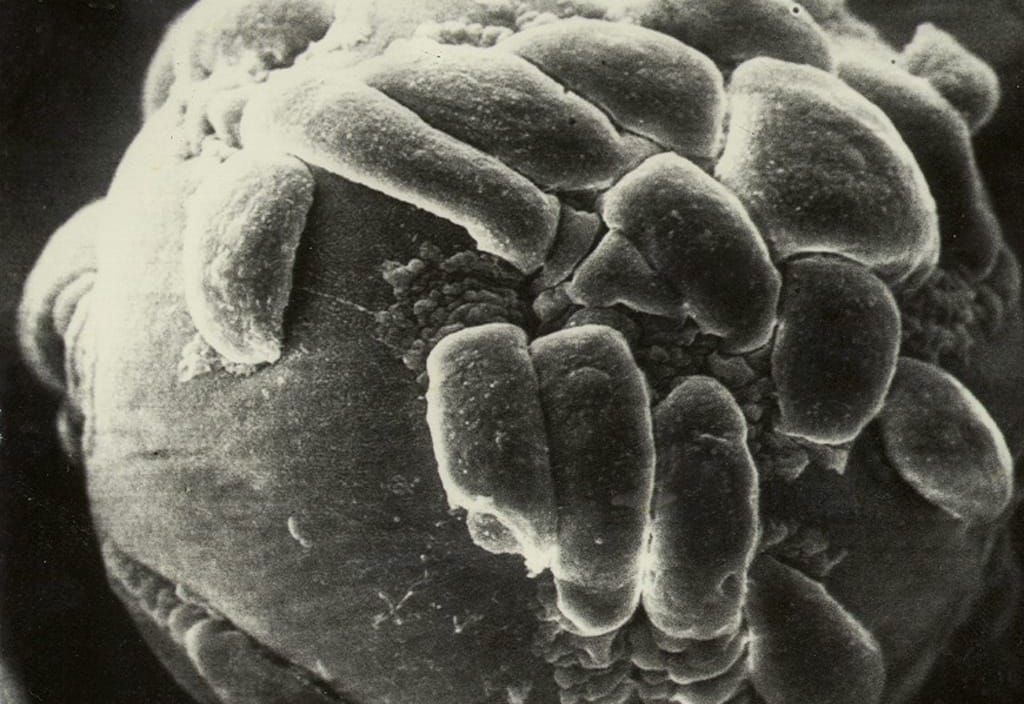
Diazotrophic cyanobacteria are interesting because of their relationship with nitrogen. Strains like Anabaena PCC 7120 are able to fix atmospheric nitrogen, hence diazotrophic. This is an important ability if cultivation on Mars should be sustainable. The Martian soil, regolith, which will be used to cultivate the cyanobacteria, contains little to no nitrogen. In order to grow, the cyanobacteria need nitrogen. However the fixation of nitrogen can't occur at the same place as photosynthesis in the cell. Specialized enzymes that make the fixation of nitrogen possible, are very sensitive towards oxygen. Anabaena for example builds special cell compartments called heterocysts, to separate the nitrogen fixation and oxygen production through photosynthesis.
- Fast growth:
Given nutrient rich medium and a lot of light, strains like Synechococcus sp. PCC 11901 have doubling times of under 3 hours in lab-conditions. However with limited infrastructure on Mars, doubling times like these are not achievable.
The key problem is that no strain has all 4 characteristics. If they are tolerant to environmental changes, they grow slowly and if they grow fast, they are sensitive to changes. This is what makes the strain selection very hard.
The Martian Environment - Three Challenges
The three main challenges scientists face on Mars are the atmosphere, light and the Martian circadian rhythm.
The Martian atmosphere has a pressure of 0.6-1.1 kPa (Earth: 101 kPa). It consists of 95% CO2, which is good for CO2 fixing cyanobacteria however, the absolute pressure is 100x lower than on Earth. Water evaporates nearly instantly. Although a team around Verseux proved that in a closed bioreactor with controlled CO2 and pressure around 5-10 kPa, cyanobacterial growth is possible. Compared to normal pressure conditions on Earth Anabaena PCC 7938 produced similar biomass at 10 kPa pressure.
Mars only gets 43% of light exposure from the sun compared to Earth. With a lot of dust in the Martian atmosphere, blue light gets scattered and the spectrum on Mars is red-shifted. The shift in the spectrum is in fact a positive aspect. Cyanobacteria use red-light efficiently through chlorophyll a. The observation is that a Photosynthetic Photon Flux Density (PPFD) of 260-1070 µmol photons m⁻² s⁻¹ is sufficient for growth but not for maximum productivity.
The solar day on Mars lasts roughly 24 hours and 40 minutes. In cyanobacteria, the internal clock is managed by the KaiABC system, which synchronizes photosynthesis, nitrogen metabolism, and cell division with environmental timing. Interestingly, as Rodrigues and McCormick point out, wild-type populations of Synechococcus elongatus possess a natural circadian period of around 25 hours. This means they could potentially be entrained to the Martian solar day with relative ease. However, whether this 25-hour intrinsic clock is a universal feature across all promising candidate strains, or if specific genetic tuning of the KaiABC complex will be necessary for other species, remains a critical open question for large-scale BLSS design. An open research problem would be to conduct studies to examine the fitness of cyanobacterial species under Martian day lengths. To date those have not been conducted.
But even if the atmosphere, light and clock can be managed, the biggest challenge may be what's under the crew's feet.
The Regolith Problem
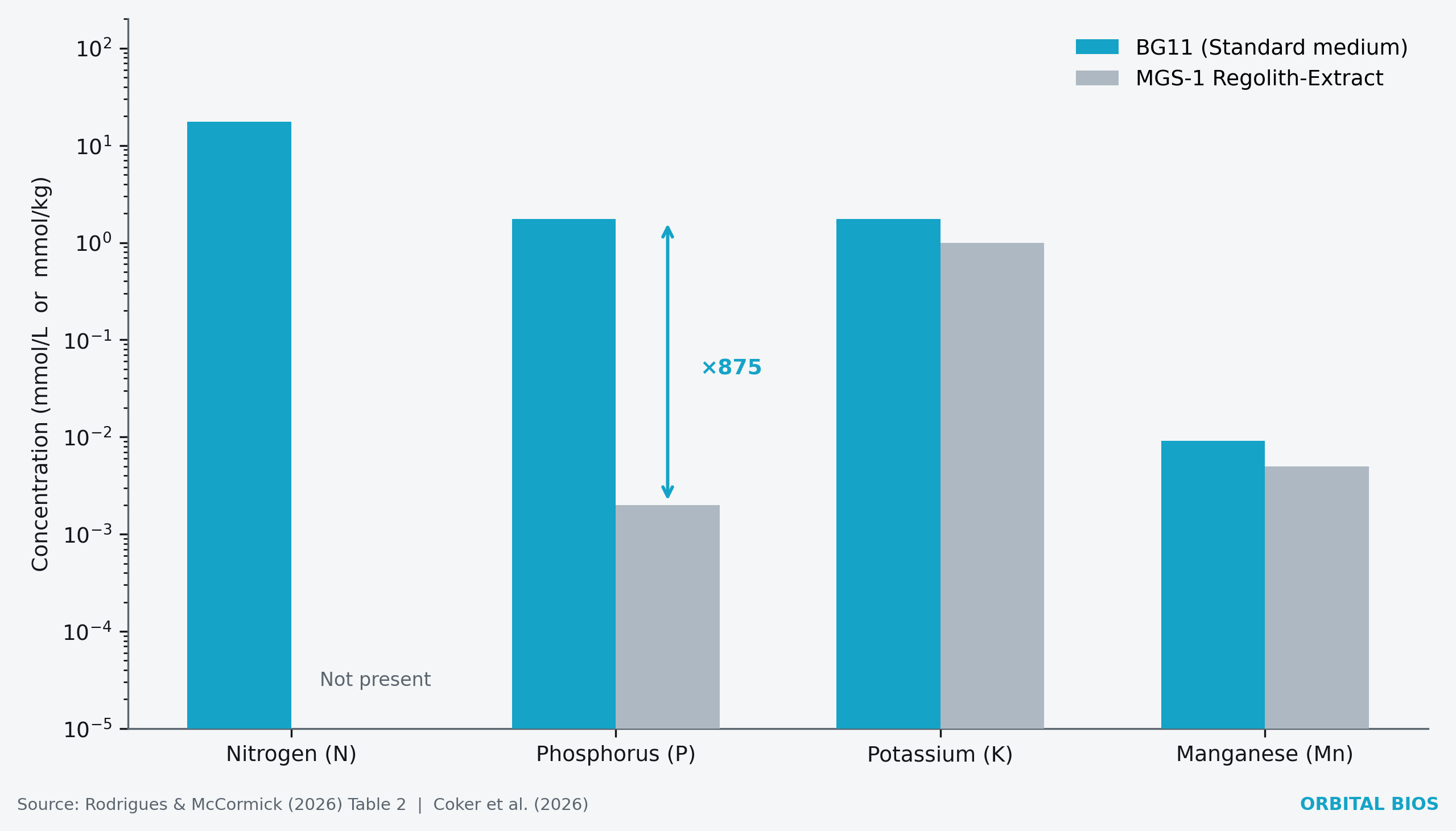
Regolith contains many necessary minerals like iron, magnesium, calcium and more, but they are enclosed in basaltic rock and mostly biologically unavailable. Figure 2 shows the difference between regolith and the standard cultivation medium BG11. In regolith, the phosphorus concentration is around 875x lower than in BG11. Nitrogen is almost completely absent and potassium and manganese are in lower concentrations as well.
Olsson-Francis and Cockell (2010) showed that strains like Chroococcidiopsis, Limnospira and Synechococcus elongatus grow 88-92% slower in regolith compared to the standard medium. Factors like nutrient availability and light blockage through insoluble regolith-particles (shading effect) reduce the growth rate.
To put it into context: A person consumes approximately 840 g of oxygen per day. Under standard laboratory conditions in BG11 medium, Limnospira platensis produces roughly 1g O₂ per liter of culture per day. To cover just 20% of one person's oxygen needs, you would need around 168 liters of culture. Now apply the regolith penalty. At 90% reduced growth that same 20% contribution requires 1,680 liters*, per person. For a crew of four, the number climbs to 6,720 liters: nearly seven cubic meters of photobioreactor, just to supplement one-fifth of the crew's breathing air.
This doesn't mean cyanobacteria are unviable. But it shows the gap between laboratory performance and Martian reality is not a detail, it's the central engineering challenge.
Assumptions
*O₂ production rate of ~1 g O₂/L/d based on Alemany et al. (2019); growth reduction of 90% (midpoint of 88–92% range, Olsson-Francis and Cockell, 2010); 20% O₂ contribution as a realistic partial target. Actual values will vary with strain, reactor design, and light availability. A linear scale-up without efficiency losses for oxygen production was assumed. The calculation assumes that the reported reduction in growth translates proportionally to volumetric O₂ productivity.
Adding to that, perchlorate in regolith (0.4-0.6 % w/w) destroys Photosystem I and II and accumulates in plants that are grown with fertilizer from cyanobacteria. If then consumed, the perchlorate becomes a health risk for the crew. A solution could be a genetic engineering strategy. Some bacterial strains, that are able to reduce perchlorate, have been isolated from the Antarctic sediment. Rodrigues and McCormick suggest to use the perchlorate reducing pathway and genetically integrate it into the cyanobacteria in the BLSS. This way the risks could be reduced, however testing is needed.
What I think
With this review, Rodrigues and McCormick have constructed the most comprehensive overview of strain selection for Martian BLSS to date. It is remarkably well-structured and systematically exposes the biological bottlenecks.
What stands out most to me is the sheer scale of the regolith penalty (the 88-92% growth reduction). When you project this isolated laboratory parameter onto a crew of four, the engineering consequences are staggering. If growth rates drop by an order of magnitude due to shading and low bioavailability, we either need a tenfold increase in bioreactor volume or extreme pre-processing of the regolith. Both options require massive amounts of energy and infrastructure, luxuries we simply do not have on Mars.
Equally surprising is that no study has tested cyanobacterial fitness under Martian day lengths. A straightforward experiment that could be run in any lab with a programmable light timer.
The review makes one thing clear: the biology works in principle. The question is whether it works at scale, on Mars, with what Mars provides. That gap is where the next decade of research will be decided.
Open Questions
- Given that S. elongatus exhibits a natural 25-hour circadian period, do you expect other prime BLSS candidates like Limnospira to adapt just as seamlessly to the Martian 24h 40min cycle, or will targeted KaiABC engineering be mandatory to prevent severe fitness losses across the board?
Further Reading
 David Rodrigues and Alistair J. McCormick