02 - Feeding Astronaut Urine Directly to Cyanobacteria
Human urine carries the nitrogen cyanobacteria need to skip a hardware-heavy MELiSSA step until regolith penalty catches up with it.

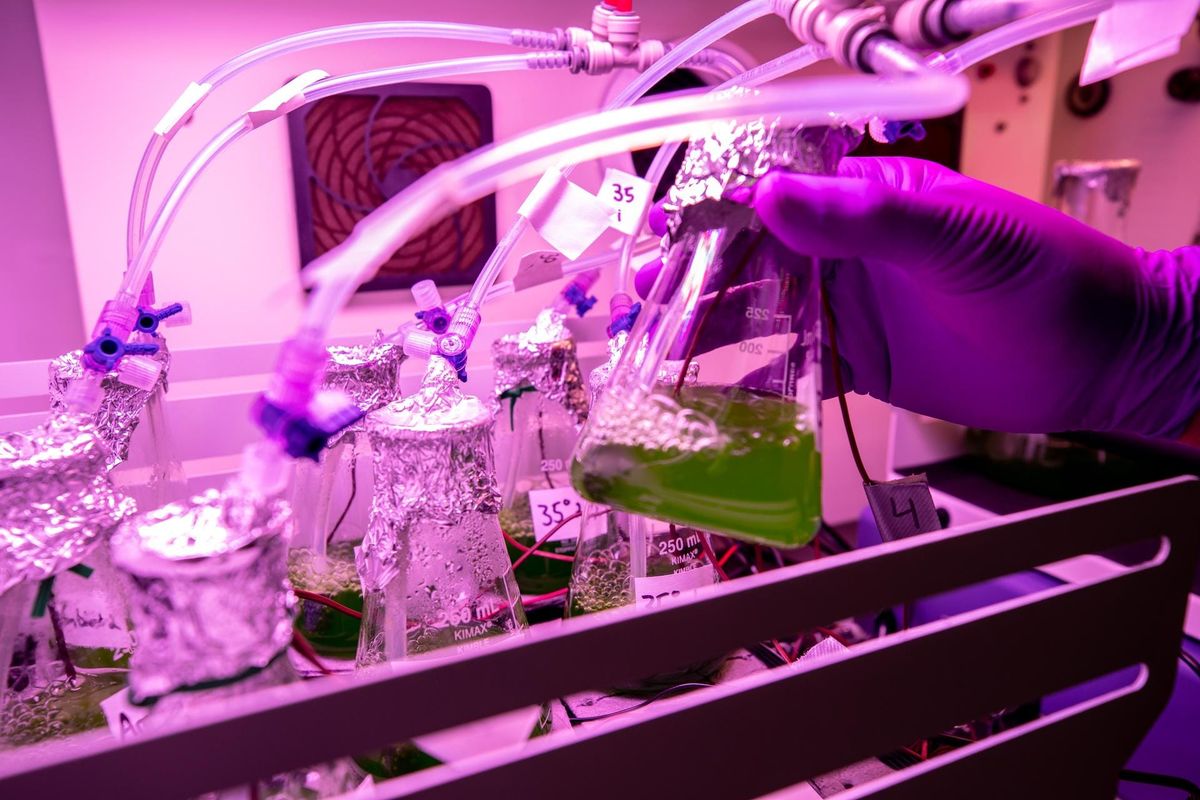
MELiSSA's nitrification compartment adds mass, energy, and a failure point to Mars-bound life support. Human urine carries the nitrogen cyanobacteria need but does it carry enough?
About 7.8%. That's how much of a photobioreactor's daily nitrogen appetite one astronaut's urine can cover, once the Martian regolith penalty from Issue 01 is factored back in. If you were hoping to delete an entire piece of life-support hardware, it's not the number you want to see.
Issue 01 established that growing Limnospira directly on Martian regolith simulant costs the culture 88–92% of its growth rate, and that covering just 20% of one crew member's daily oxygen demand under those degraded conditions requires 1,680 liters of active photobioreactor volume — 6,720 liters for a crew of four. That math was about oxygen. It said nothing about nitrogen. And nitrogen is exactly where a second, much more hardware-heavy compartment sits in every serious BLSS architecture: nitrification.
The question this issue asks is simple to state and expensive to answer: could a Mars-bound life support system just skip nitrification and feed cyanobacteria on raw, unprocessed human urine? The biochemistry says yes. The mass balance, once you actually scale it to Issue 01's own numbers, says: not on its own.
The Nitrification Bottleneck
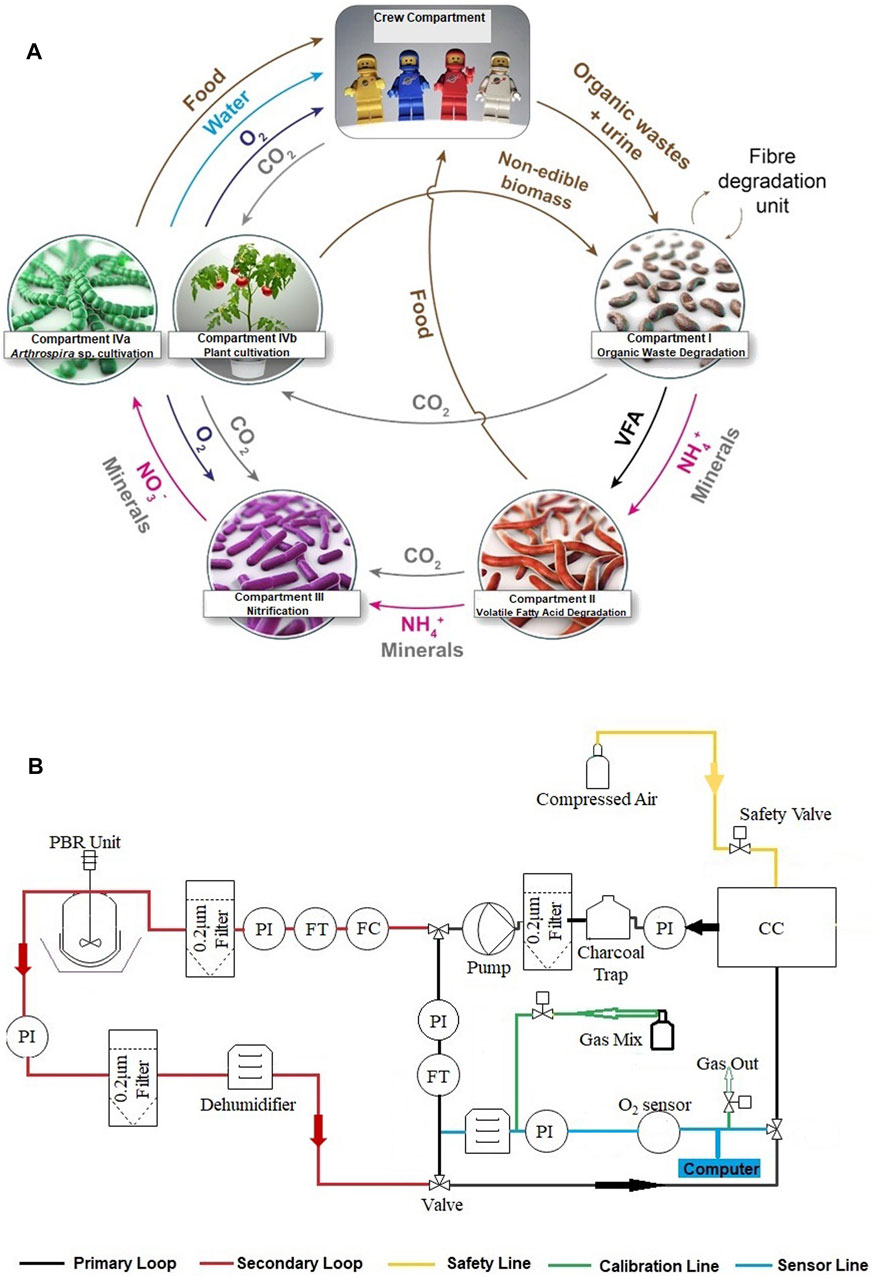
The reigning architecture for closed-loop bioregenerative life support is the European Space Agency's MELiSSA (Micro-Ecological Life Support System Alternative) project, deliberately modeled on the layered metabolism of a natural lake ecosystem. The process runs sequentially: thermophilic anaerobic bacteria first break down human waste and inedible plant biomass into volatile fatty acids (VFAs), CO₂, and ammonium (NH₄⁺). Purple photosynthetic bacteria oxidize the VFAs further. Nitrifying bacteria then convert that ammonium into nitrate (NO₃⁻). Only at the very end do the producer compartments (Limnospira and higher plants) consume the nitrate and CO₂ to generate edible biomass, potable water, and oxygen for the crew.
It's an ecological masterpiece, and the nitrification step exists for a specific reason: cyanobacteria strongly prefer nitrate as their nitrogen source, and the ammonium that dominates raw urine becomes toxic once its concentration climbs. At the alkaline pH these reactors typically run at, a meaningful share of that ammonium shifts toward free ammonia which is the actual cell-damaging species. Nitrification exists specifically to keep that shift from ever happening.
From a strict aerospace systems-engineering perspective, though, that safety margin has a cost: a dedicated bioreactor step that adds mass, continuous energy draw, and a failure point. Human urine already carries the nitrogen cyanobacteria need, it's just in the wrong chemical form. Which raises the obvious, expensive question: what if we feed that raw stream directly into the cyanobacteria tanks and skip nitrification entirely?

Hardware in the Loop: The 35-Day Ground Demonstration
To test whether Limnospira indica can actually handle raw, non-nitrified waste without a culture collapse, the relevant data comes from a 2021 ground demonstration by Sachdeva and colleagues, "Ground Demonstration of the Use of Limnospira indica for Air Revitalization in a Bioregenerative Life-Support System Setup", published in Frontiers in Astronomy and Space Sciences.
Rather than testing this in isolated lab flasks, the team built a closed, automated gas-exchange loop that physically linked two components. The producer: a 2.0-liter, double-jacketed photobioreactor (PBR) running a Limnospira indica culture, continuously mixed with a Rushton turbine and radially illuminated by 14 cool-white light bulbs, capable of a maximum incident light flux of 147.1 W/m². The consumer: an 11.5-liter stainless-steel metabolic chamber housing a single 21.2-gram C57BL/6J male mouse, held at a minimum airflow of 55 L/h for adequate gas mixing. A mouse stood in for human metabolism here, meeting ethical and logistical constraints while still generating physiologically meaningful gas-exchange data to control the loop against.
The more interesting engineering detail isn't the biology, it's the control law. Rather than blasting the culture with constant light, a model called Photosim 2.0 continuously predicted how much light each part of the reactor was actually receiving (light attenuates fast as it travels deeper into a dense culture) and adjusted the lamp output in real time to hold the mouse chamber at exactly 20.3% oxygen.
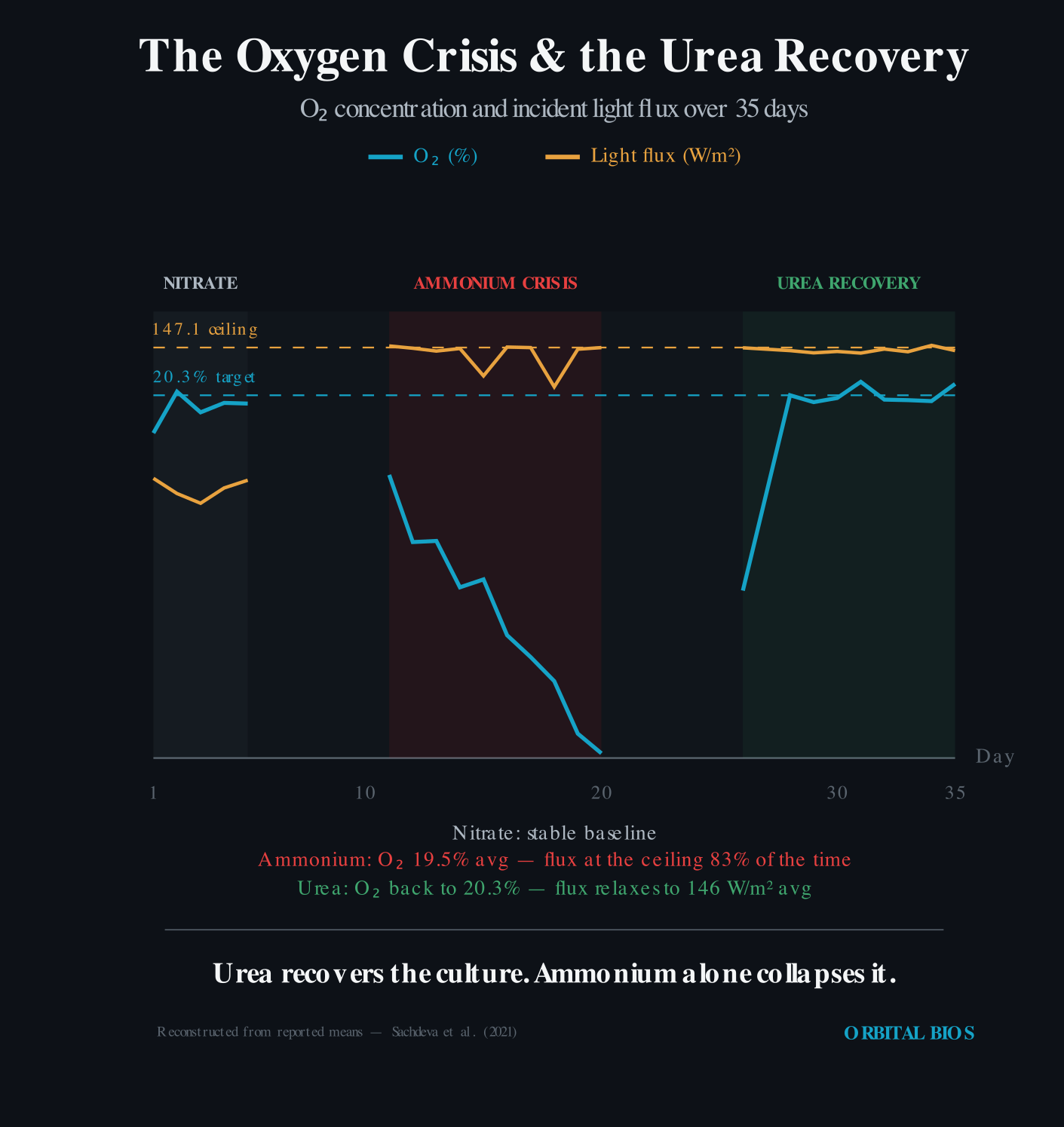
Over the 35-day run, the team cycled through three nitrogen sources: nitrate as the baseline (days 1–5), ammonium (days 11–20), and urea (days 26–35). The transition periods between regimes were deliberately excluded from the reported numbers, since the model's predictions become unreliable exactly when competing nitrogen sources disrupt the system's steady state. That means the "clean" performance data below reflects the system once it had settled and the worst-case performance during the actual transitions isn't in these numbers.
Why Ammonium Fails
When the feed switched to ammonium-only, the system began losing ground. As oxygen levels dropped, the controller responded by demanding more light, pushing the reactor to its full 147.1 W/m² ceiling for roughly 83% of the recorded time. Despite that sustained maximum input, oxygen still fell to an average of 19.5% short of the 20.3% target. The cyanobacteria visibly deteriorated: cells bleached from deep green to pale green, and thick biofilms formed on the reactor walls.
The chemistry behind this is entirely predictable. The reactor was held at pH 8.5 to keep carbon available for growth. But ammonium exists in a pH-dependent equilibrium with free ammonia:
NH4+ + OH- ⇌ NH3 + H2O
With a pKa around 9.25, running at pH 8.5 pushes a meaningful share of the total nitrogen pool toward the uncharged form, NH₃. That distinction matters: charged ammonium needs a transporter protein to enter the cell, but uncharged free ammonia is lipophilic and passes directly through the cell membrane without needing one.
Once inside, it disrupts intracellular pH and uncouples the proton gradient across the thylakoid membrane, the same gradient that drives ATP synthase during photosynthesis. The models suggested the system would have needed 155.8 W/m² to compensate for the resulting 21.5% drop in oxygen yield. The hardware simply couldn't get there.
The Urea Recovery
When the feed switched to urea on day 26, oxygen climbed straight back to the 20.3% setpoint. Light flux, which had spent 83% of the ammonium phase pinned at its 147.1 W/m² ceiling, settled to a comfortable average of 146 W/m². The biofilm cleared, and the cultures regained their color.
The chemistry explains why urea and ammonium (both nitrogen sources, both present in urine) produce such different outcomes. Inside the cell, the enzyme urease hydrolyzes urea:
CH4N2O + H2O urease→ 2NH3 + CO2
That reaction also produces ammonia but the difference is where and how. It's generated inside the cell, gradually, under enzymatic control, instead of diffusing in from outside across the membrane. And the CO₂ released alongside it gives photosynthetic carbon fixation a direct, localized boost. Urea isn't just a nitrogen source here; it acts as a bioenergetic assist that lets the cell absorb a nitrogen load that raw external ammonium can't.
Worth flagging early: this recovery used synthetic urea, not real urine. Real urine carries hundreds of additional compounds urea alone doesn't. Whether that changes the outcome is a question this study can't answer and it's one we'll come back to.
Does It Scale to a Human? The Mass Balance
Sachdeva and colleagues proved urea-bypass works at the scale of a 21-gram mouse and 2 liters of culture. Scaling that to an astronaut and to the photobioreactor volume Issue 01 actually established means running the numbers and this is where the regolith penalty comes back into the story.
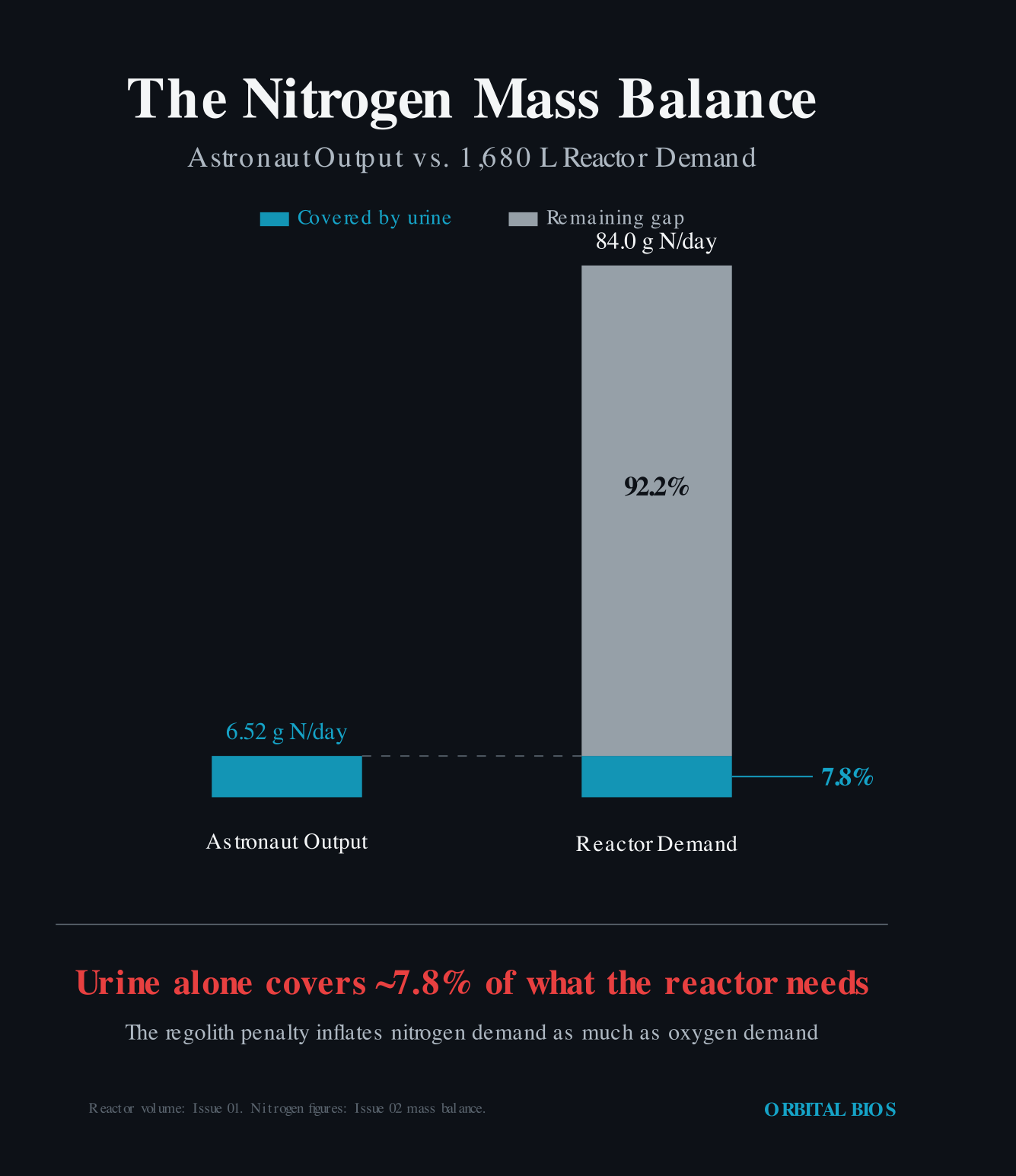
Step 1 — the astronaut's output. On a high-protein mission diet, an adult excretes roughly 1.5 liters of urine per day, containing an estimated 12–15 g of urea; take 14 g/day as a baseline. Urea (CH₄N₂O) has a molar mass of 60.06 g/mol, of which two nitrogen atoms account for 28.02 g/mol — so urea is about 46.6% nitrogen by mass:
14 g × 0.466 = 6.52 g N/day
Step 2 — the bioreactor's demand. Issue 01 calculated that covering 20% of one crew member's oxygen needs under Martian regolith growth conditions (a 90% growth reduction) requires 1,680 liters of active photobioreactor volume. At a conservative continuous growth rate of 0.5 g/L/day, that 1,680-liter reactor produces 840 g of dry Limnospira biomass daily. At roughly 10% nitrogen by dry weight, its daily nitrogen appetite is:
1,680 L × 0.5 g/L/day × 0.10 = 84.0 g N/day
Step 3 — the gap. 6.52 g of usable nitrogen against an 84.0 g demand means untreated urine alone covers:
6.52 ÷ 84.0 ≈ 7.8%
of what a regolith-scale reactor actually needs. Scaling this up to a full crew doesn't change the ratio because urine supply and reactor demand both scale linearly with crew size, so pooling waste across four people still leaves you at roughly the same 7.8%.
This is the regolith penalty showing up again, in a different budget. The same tenfold volume increase that made the oxygen math brutal in Issue 01 makes the nitrogen math brutal here: the reactor got ten times bigger, but a person's urine output didn't.
It's also worth being explicit that this calculation assumes 100% of the nitrogen in urea is available to the cyanobacteria. Real urine won't hit that number either, it dilutes urea with creatinine, hormones, salts, and other degradation products. Sachdeva et al.'s biological result held with synthetic urea; that's encouraging for the chemistry, but it doesn't rescue the mass balance.
Limitations and What Comes Next
Sachdeva et al.'s ground demonstration is a genuine proof of concept for the chemistry, but it comes with limitations the authors themselves flag. The study fed the culture pure, synthetic urea and ammonium, not real human urine. And strict animal-welfare limits capped the mouse's time in the chamber at 40 days, which forced the experiment to target a gas steady state rather than a true liquid steady state. Reaching the latter would have required running each nitrogen regime for at least three full residence times, roughly 15 days each, well past what was ethically permitted here.
Real urine isn't a sterile flask of urea. It's a fluctuating mix of salts, organic metabolites, hormones, and trace hygiene compounds. Feeding that into the loop pushes Limnospira from a strictly photoautotrophic metabolism toward a mixotrophic one, which can shift its C:N ratio and, with it, its oxygen output, in ways this study never tested.
The next frontier isn't proving the concept works for 35 days. It's proving it works for 1,000.
What I think
The chemistry here genuinely convinces me. Urea outperforming ammonium isn't a marginal effect, it's the difference between a collapsing culture and a stable one, and the mechanism behind it (localized, enzyme-controlled ammonia release plus a CO₂ boost) is a clean explanation, not a post-hoc story.
The mass balance is the part that tempers my enthusiasm. Going in, I expected pooling urine across a crew to buy some slack; it doesn't, because both sides of the equation scale with crew size. What actually determines the coverage ratio is the size of the reactor relative to the person, and Issue 01 already showed that the Martian regolith penalty inflates that reactor by an order of magnitude. Nitrogen didn't become a bottleneck because urine is nitrogen-poor. It became a bottleneck because the regolith penalty made the reactor nitrogen-hungry.
That reframes the question. Removing nitrification isn't primarily about whether cyanobacteria can tolerate raw urine, Sachdeva et al. showed they can. It's about where the other roughly 92% of nitrogen comes from: solid-waste degradation, diazotrophic fixation, or a reactor architecture that doesn't carry a tenfold volume penalty in the first place. The experiment I'd actually want to see next isn't a longer version of this one. It's the same setup, run with real urine instead of synthetic urea, paired with an honest accounting of every other nitrogen source available in a closed habitat.
Open Questions
- Sachdeva et al. proved the biology with synthetic urea. Would real, unprocessed astronaut urine with its full load of creatinine, hormones, and salts still deliver a 20.3% oxygen recovery, or does the added organic complexity push Limnospira's metabolism somewhere this mouse-chamber data can't predict?
Assumptions
Urea output assumed at 14 g/day (midpoint of a 12–15 g/day range for a high-protein mission diet); urea's nitrogen content taken as 46.6% by mass (28.02 g N / 60.06 g urea, by molar mass); photobioreactor volume of 1,680 L and the Martian-regolith growth penalty carried over directly from Issue 01; biomass growth rate assumed at 0.5 g/L/day; Limnospira dry biomass assumed to be 10% nitrogen by mass; nitrogen availability from urea assumed at 100%, which real, unprocessed urine would not achieve. Actual figures will vary with reactor design, diet, and urine composition.
Further Reading



 Faneez Polat